CHILDREN's MENTAL HEALTH · North Narrabeen
Questions parents ask
A few things families often want to know before they get in touch. If your question is not here, an email is always welcome.
Who benefits from CCPT?
CCPT works well for children who are struggling with emotional, behavioural, social and relationship difficulties that affect their sense of well-being and ability to learn and grow optimally.
CCPT does not resolve problems of a neurological, biological or organic nature, such as ADHD or biochemical depression. But it is a highly effective complementary treatment for children with these diagnoses, as they tend to have concurrent emotional problems.
What skills can a child develop from engaging in play therapy?
There are four universal outcomes of Play Therapy, regardless of the reason why the child began treatment: Increased self-esteem, increased regulation, increased worldview and increased emotional vocabulary.
These, in turn, lead to an improvement in prosocial and problem-solving skills, as well as a greater sense of self, independence, autonomy, empathy, and responsibility for own actions and behaviours.
How many sessions will my child need?
The duration of treatment can range between 20 and 40 sessions or more, depending on each individual child.
What is the therapist's role?
While the therapist’s role is non-directive, it is not a passive one. The therapist remains active and disciplined throughout treatment by doing the following:
• Using their skills in a consistent, predictable manner to create an environment that promotes the child’s self-expression and self-direction.
• Tracking (describing) a child’s actions in play to increase self-awareness and facilitate the relationship.
• Reflecting content by summarising or paraphrasing the child’s verbal expressions. This allows the child to feel seen, heard and understood.
• Reflecting feelings (naming or validating feelings) to increase awareness of emotions, learn to accept them and, ultimately, express them verbally.
• Setting consistent limits — gently but firmly — when the child is testing them in session.
• Facilitating experiences of co-regulation.
• Building self-esteem, providing encouragement and sense of self building statements.
• Facilitating decision making and returning responsibility.
• Being an attuned, empathic and unconditional witness throughout the child’s healing journey.
Pre-consultation video
A short video to watch before our first conversation, so you can see how CCPT works and what to expect.
CONTENTS
Section 1 - Introduction 0:01
Section 2 - The Play Therapy Process 1:42
Section 3 - Phases of Treatment 2:04
Initiation Phase 2:12
Resistance Phase 2:39
Work Phase 3:09
Termination Phase 3:20
Section 4 - Universal Outcomes 3:54
Section 5 - Parent Involvement 4:24
Section 6 - Confidentiality 4:57
Themes: The Metaphors of Play 5:39
Section 7 - Wrap Up 6:15
opening hours
Tuesdays, Wednesdays and Thursdays, 9:00 am to 4:00 pm.
Fridays, 10:00 am to 2:00 pm.
Session Length
Not including room reset and clinical note writing time.
- Play therapy45 minutes
- Parent reviews50 minutes
- Adolescent counselling50 minutes
- Intake sessions60 minutes
Address
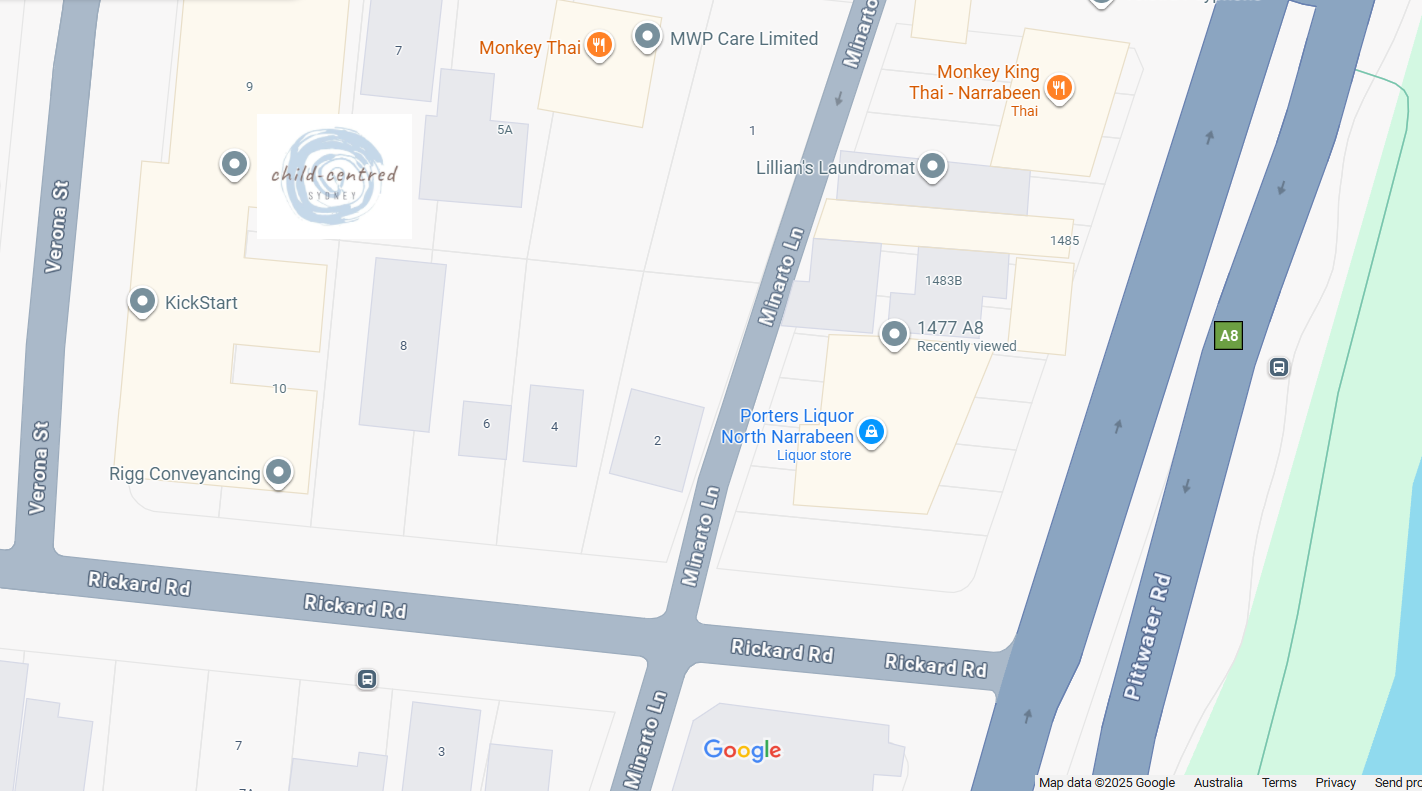
Suite 6 / 12 Rickard Road
North Narrabeen NSW 2101
Parking
Free parking lot across the road. Free 8P bays in front of the building and on-street parking. Entrance via Verona Street.
Next step
Still wondering about something?
Send a short note about your child and what you are noticing, and we can talk through whether play therapy is a good fit.